AutoCAD drawings
Technical drawings ready for the build, the installer and the planning office.

Buying a court
Factory price, technical drawings and live order tracking. From Valladolid to 28 countries.
300+
courts a year
28
countries
0
middlemen
Scope
Three deliverables that ship with every court and that a distributor does not produce.
Technical drawings ready for the build, the installer and the planning office.
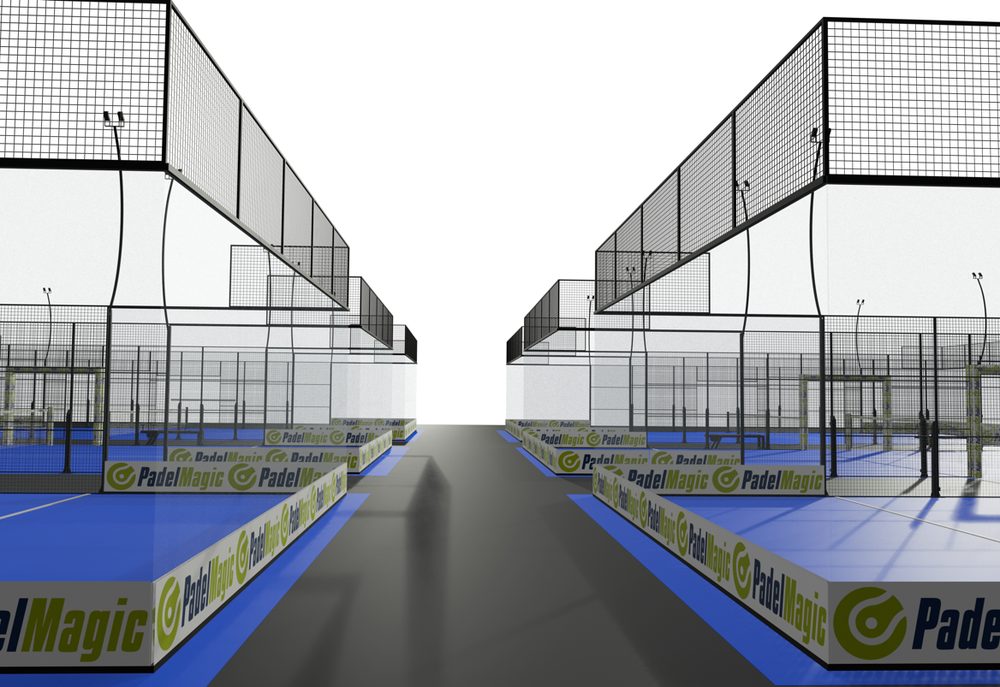
With the quote, how your facility will look. At no cost.
Calculated for the wind and snow of your site, not from a catalogue.
Traceability
When you sign you get access to the intranet we manufacture with, filtered to your project: the real phase, the proformas and the documentation, on desktop and mobile. A distributor cannot offer this because they are not in the factory.


Client area on tablet and installer app on the phone: the same order on both screens.
What is in
The price of each court is set in the quote, with this scope in writing.
| Item | Supply | Note |
|---|---|---|
| Structure | Included | Tube cut, welded, hot-dip galvanised and painted in the plant |
| Tempered glass | Included | 18 panels of 3×2 m · EN-1250-1 / EN-1250-2 |
| Turf | Included | With silica sand and playing net |
| Lighting | Included | 8 linear LED floodlights, 200 W, dimmable |
| Fasteners and bushings | Included | DIN 7380 · machined bushings in 4 mm |
| Foundation | Not included | Separate civil works · we send the drawings with the loads |
| Assembly | Optional | With our team, or an installation guide for yours |
Buying guide
Padel courts are the result of complex engineering that involves every part of the court: metal structure, tempered glass, turf, fasteners, lights, net, posts and so on. Each must have a specific density, dimensions and properties so the result is a court where the sport can be played safely and efficiently. So everything fits together perfectly.
In PadelMagic's case, we manufacture and design our courts in Valladolid (Spain) and distribute them worldwide. We have a team of experts in each area, working in sync with the requirements of every client. A court's characteristics depend on which of our three models you choose: ECO Frames, Panorama, TOP Professional, or the portable one.
The differences between each court are aesthetic, structural and in how the glass and structures are joined for the finish; one suits you better than another depending on the type of play required. The ECO Frames, for example, has 18 tempered glass panels of 3×2 metres in 10 mm, plus 30 metal structure modules, while the Panoramic has the same panels in 12 mm, but the glass is joined directly with structural silicone or methacrylates, not by a metal structure.
But to get to the point, after all this information: how much does a padel court cost? The price can vary, but as a general rule they range from 15,000 to 20,000 euros plus VAT per court.
Another element to factor into your court purchase and operation project is the cost and construction of the foundation the courts sit on — the padel court slab we explain at the previous link. The slab usually costs around 7,000–8,000 €.

It's a recurring question, and the answer is yes and no. You have to answer these questions: is the court outdoors? Is the court near the sea or in salty environments? If the answer is yes, you'll very likely need to galvanise the court to prevent corrosion and rust. When it comes to the durability and safety of a sports court, galvanising becomes a key factor. Galvanising a court not only increases its resistance to corrosion, it also guarantees a much longer service life, reducing maintenance costs and offering greater confidence to clubs, municipalities and companies looking for a safe investment. ### Advantages of galvanising a court
galvanised steel performs much better in humid, salty or industrial environments.
frequent repairs due to wear or rust are avoided.
galvanising protects the court against damage that could compromise its strength.
a galvanised court stays in perfect condition for many more years.
with the right galvanising, the court can meet international corrosion-resistance standards.
### Most common types of galvanising for courts
the most common, by immersing the steel in molten zinc, providing full coverage.
more aesthetic, though less resistant than hot-dip.
used on smaller parts or specific structural components.
Each type of galvanising is selected according to the court's level of exposure and the environmental conditions of the area.
### The C3, C4 and C5 anti-corrosion certificates
One of the most critical aspects is anti-corrosion certification. In Europe the levels C3, C4 and C5 are used, defined by the ISO 12944 standard, which establish a protection system's resistance to corrosion:
C3: adequate protection for urban or low-humidity environments.
C4: designed for industrial or coastal areas with moderate salinity.
C5: the most demanding level, for high-salinity marine atmospheres or aggressive industrial environments.
### The truth about certificates: not all are valid
It's essential to clarify that it's not enough for the court manufacturer to simply claim a certificate. The certification must be real, issued by an accredited body and backed by actual testing.
In Spain, we are the only company able to offer a real, certified anti-corrosion guarantee at the C3, C4 and C5 levels.
### Conclusion
Investing in a galvanised court with a real C3, C4 or C5 certificate is not an expense but a guarantee of durability, safety and long-term profitability.
The next step after confirming the court purchase is getting it from our factory to its final destination. ### Shipping courts from factory to final destination: containers, logistics Transporting a sports court from the factory to its final destination is a key process that must be carefully planned. The packaging and the type of container used are decisive in ensuring everything arrives in perfect condition. A standard 20DV container fits only one complete court. That's why, depending on the number of courts and the destination, we assess the most efficient option. Bear in mind that Open Top containers have an additional cost but allow bulkier loads to be handled more easily. ### Most common Incoterms in court shipping In international trade, Incoterms regulate the delivery conditions between seller and buyer. The most common in our shipments are:
the seller makes the goods available at the factory and the buyer takes on the transport.
the seller delivers the goods on board the ship at the port of origin.
the seller covers cost, insurance and freight to the destination port.
We advise each client on the option that best suits their case.

Worth considering if you want an extra beyond the padel court itself:
Custom club logo on the court (free)
Protections with logo
Special turf colours
Perimeter LED lighting
Scoreboard and technology
Covers and enclosures
In any international operation, clearing customs is a process that must be handled with care. ### Basic documentation to export sports courts When shipping a court from the factory to the destination country, there are certain documents that are always required:
the detailed list of the cargo, specifying content, weight and dimensions.
the document that certifies the commercial value of the operation.
proof of the shipping contract.
### Additional certificates we offer
Beyond the basic documentation, in many cases it's necessary to present additional certificates:
allows tariff advantages to be obtained in exports to countries with trade agreements.
certifies where the goods were manufactured.
### The importance of professional customs management
An error in the documentation can cause delays, extra costs or even the retention of the goods at customs.
### Conclusion
The success of an export depends not only on transport, but on impeccable documentation management. With the right experience and processes, we can guarantee that every court arrives at its destination without setbacks.
Correct installation of a padel court is as important as its manufacture. A well-installed court guarantees safety and durability. ### Available assembly options
our specialist team handles the complete installation.
we send a technician to direct your local team.
with our step-by-step guide and technical plans.
### Client responsibilities in unloading and placing the material
It's important to stress that each court's material must be unloaded and placed at the installation site by the client, with the appropriate means (forklift or crane depending on the case).
### Service exclusions
PadelMagic does not under any circumstances handle electrical, plumbing or civil works. Nor the construction of the slab, which the client must have ready beforehand.
### Conclusion
Installing a padel court requires experience and organisation. That's why we offer several options so each client can choose the one that best fits their needs.
The estimated assembly time is 2.5 days per court with our team.

Transparency and security are fundamental values in any commercial operation. ### Online contract signing To simplify management and guarantee maximum transparency, we offer online signing of the contracts involved in the operation:
setting out in detail the obligations of each party.
when assembly by our team is contracted.
for cases requiring additional intervention.
This system ensures that both parties know their responsibilities from the outset.
### Official material guarantees
All materials used carry CE certification, which guarantees they meet European standards.
This way, the client not only receives a top-quality court, but also the peace of mind of documented guarantees.
### Conclusion
At PadelMagic we don't just manufacture and assemble padel courts, we also guarantee the whole process with clear contracts and certified materials.
At PadelMagic, for clubs that want a fully passive income, we offer complete court automation. Padel court automation has become a necessity for clubs looking to optimise resources and maximise profitability. ### An exclusive solution with proven experience Our proposal is not a generic solution. It's based on the ReservaDeportes platform, with years of experience managing bookings and access for hundreds of clubs. ### Advantages of automating padel courts
bookings and access with no need for physical staff.
the club runs on its own.
you know at all times who entered and when.
courts available every hour of the day.
### Automation without needing internet
One of the features that make our solution unique is the ability to operate even if the club's internet goes down: the court keeps opening thanks to its own 4G SIM.
### Tailored solutions
Every club or facility has different needs, which is why we offer customised solutions adapted to each case.
### Conclusion
Padel court automation is not a passing trend, it's the present. With our experience and technology, we help every club improve its profitability.

In the end, we're here because padel is an excellent sport, and one that's booming. Every padel club aims to rent out its courts by the minute or hour. Profitability depends on several factors:
very important, covered in the previous points.
how many hours a day the courts are booked.
adjusted to your area and type of client.
bar, shop, classes, tournaments.
### Put numbers to your project
Set up your court and get the detailed quote in your email. Realistic prices, no surprises.
Tell us how many courts and where. We send it with the breakdown and the render.
info@padelmagic.es · +34 606 392 955
We use our own cookies that are needed for the site to work and, only with your permission, measurement cookies to see which pages get visited so we can improve them. You can accept them, reject them all or choose. Read the cookie policy
Necessary
Essential for the site to work and to remember your cookie choice. They cannot be switched off and are not used to track you.
Measurement
They tell us how many people visit each page and where they come from, in aggregate. We use them to decide what to improve. If you reject them, the site works just the same.
Advertising
These would measure how well adverts perform. We do not use any at the moment: the option is here in case we add them later.